Industry / government-funded project
Combat sleeping bag
An ergonomically optimised, modular sleeping system for extreme operational environments in South Korea.
Project facts
- Period
- Nov 2022 – Feb 2026
- Funding / client
- KRIT
- My role
- UX Researcher, Product Designer
- Organisation
- IID Lab, UNIST
Context
Developed with NH Co., Ltd. under a national civil-military R&D programme (KRIT), this sleeping system is designed for both military and commercial use. It targets special-forces operations in extreme cold: winter minimum temperatures on the Korean Peninsula range from −25 °C to −35 °C.
Challenge
Existing military sleeping bags are rated at only 4–5 clo, too little for winter operations, and current winter bags are heavy and bulky to carry. The new system had to be warmer, lighter and easier to pack, and still work for the operators who use it in the field.
My role
- User research and guidelines. I contributed to product design and participated in user research with special-forces personnel to derive design guidelines and requirements, and I am first author of the paper that publishes them (IEA 2024).
- Benchmarking. I benchmarked military and commercial sleeping systems.
- Drawings. I revised the design drawings in response to the manufacturer's numbered review comments (2024).
Process
- Desk research and benchmarking — 11 articles and 18 patents, plus military and commercial sleeping bags, to understand insulation, shape and modular features.
- Expert interviews — four experienced outdoor and sleeping-bag experts, including a former special-forces member, in semi-structured sessions of about three hours each.
- Special-forces input — interviews and a 24-question survey with 12 personnel from the Special Warfare Command. Recording was not allowed, so four researchers took notes and cross-checked them in a workshop before thematic analysis.
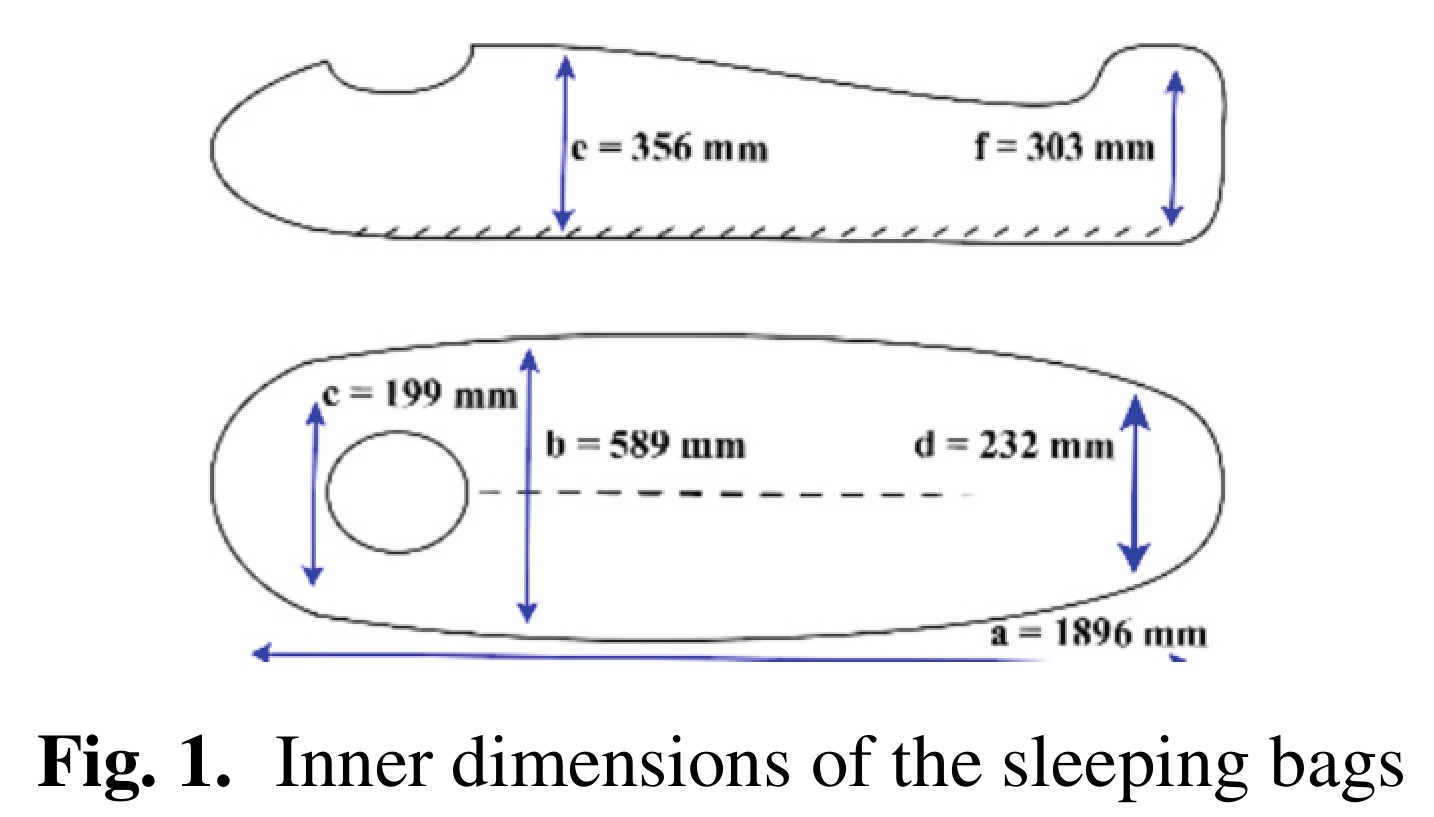
- From guidelines to drawings — the guidelines were turned into usage scenarios (setup, use and pack-up) and then into dimensioned design drawings, revised with the manufacturer.
Deliverables
- Design guidelines covering insulation, shape, size, mass and modular features — including a 6.5 clo thermal target, a mummy-type shape and features such as hot-pack pockets
- Proposed inner dimensions and usage scenarios
- Revised design drawings for the manufacturer
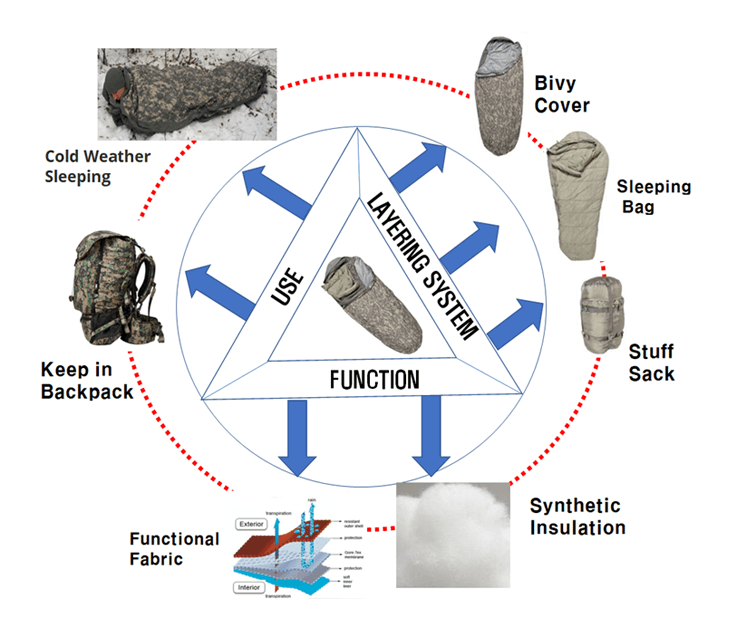
The system combines a mummy-style design with high thermal insulation and a modular layering system (sleeping bag, bivy cover and stuff sack).
Outcomes
Design guidelines published in the IEA 2024 congress proceedings (Springer, 2025); detailed design drawings.
Related work1
Design Guidelines for Special Forces Sleeping Bags: Addressing User Needs in South Korea
Ismatullaev, U. V. U., Kwon, U., Kim, J., Lee, D., & Kim, K.
Conference paperProceedings of the 22nd Congress of the International Ergonomics Association (IEA 2024), Vol. 6, pp. 209–217, Springer Nature Singapore2025DOI 10.1007/978-981-96-8904-0_28