Industry / government-funded project
AI platform for the design–production process
Collision element prediction and optimisation in the design–production process: building the Design Unique Values (DUV) framework and CMF evaluation datasets for AI.
Project facts
- Period
- Jun 2025 – present
- Funding / client
- KEIT
- My role
- UX Researcher
- Organisation
- IID Lab, UNIST
Context
An ongoing national R&D project (MOTIE/KEIT, 2025–2028) developing an AI platform that predicts and resolves conflicts between design intent and production constraints — while preserving what makes a design distinctive. A consortium of companies, research institutes and universities works on the platform; UNIST's part is to define the Design Unique Values (DUV) of a product and how to evaluate them. For the project proposal our team designed the first UI concepts of the platform; a consortium partner will develop the platform's UI further.
Challenge
Design quality is usually judged by intuition and preference votes, and existing research on product form is fragmented across semantics, perception and geometry. To train AI on it, the qualities designers care about have to become explicit, measurable and consistently rated.
My role
I contribute to the DUV framework and to the evaluation of product form and colour, material and finish (CMF) used to build AI training datasets:
- reviewed the literature on form evaluation and defined twelve form indicators, each with measurable parameters;
- planned the 2026 research in four phases, from form categorisation to CMF evaluation;
- designed the expert-workshop protocol for form categorisation and revised it after a pilot test;
- lead the CMF evaluation design — research framework, workshop protocol and data structure.
Process
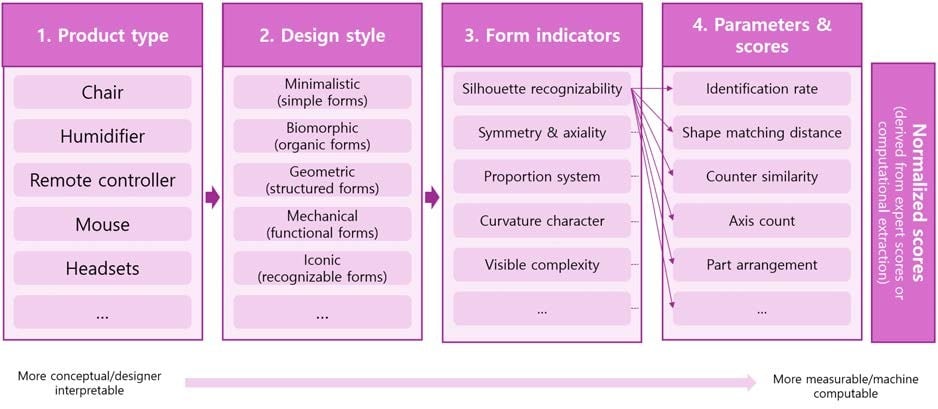
From design language to parameters. The framework links four levels: product type, design style, form indicators (such as silhouette recognisability, symmetry or proportion) and the measurable parameters behind each indicator, which can be turned into normalised scores.
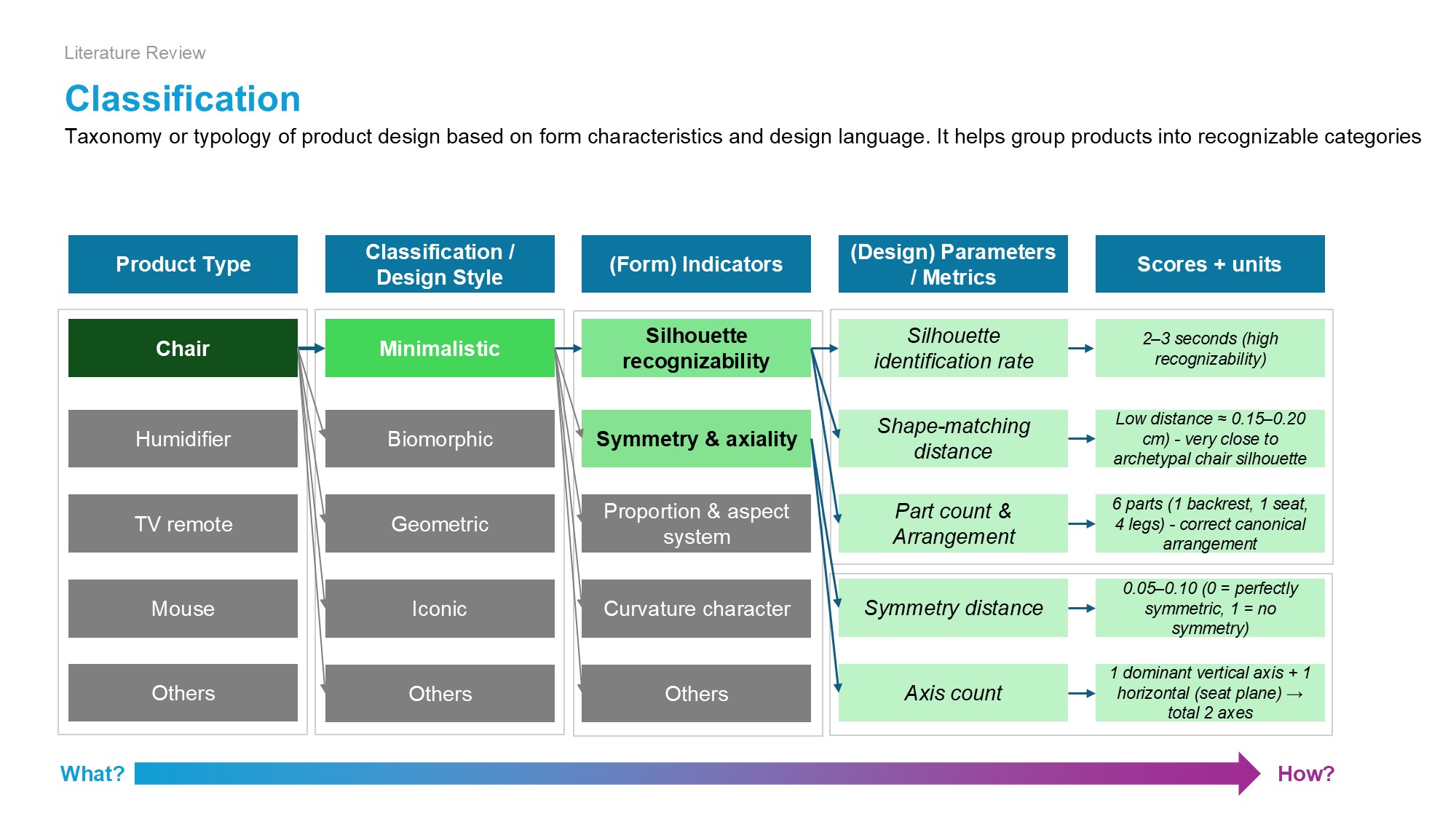
Expert workshops. In a pilot workshop (3 participants, 50 product images, 79 minutes) experts grouped products by form. The pilot showed where the protocol needed work: categories mixed geometry, style and emotion, colour and materials influenced form judgements, and the quality of answers dropped after about an hour. The revised protocol uses de-branded grey “clay” renders from a fixed viewpoint with a scale marker, more product types, example images and shorter sessions.
CMF. The current phase extends the approach to colour, material and finish — how CMF changes the perceived value of the same form.
Deliverables
- Literature review and the form-indicator framework (KSDS 2026 paper)
- Research plan and workshop protocols for form and CMF evaluation
- Pilot findings and protocol revisions
The framework is conceptual and has not yet been validated empirically; the main expert workshops and the DUV dataset are in progress.
Outcomes
DUV evaluation framework; expert workshops on form and CMF categorisation; KSDS 2026 paper on AI-learnable product form evaluation.
Related work1
Toward an AI-Learnable Product Form Evaluation: Linking Design Language and Quantifiable Parameters
Ismatullaev, U. V. U., & Kim, K.
Conference paperKSDS Conference Proceedings, pp. 376–3812026