Conference paper2023
Dynamic personalities for elderly care robots: user-based recommendations
Lee, D., Kim, K., Saduakas, A., Ismatullaev, U. V. U., Kim, J., & Barrera Garza, B. P.
IASDR 2023
Publication details
- Type
- Conference paper
- Published in
- IASDR 2023
- Year
- 2023
- License
- Open access · CC BY-NC 4.0
In brief
The paper argues that robots caring for older adults need personalities that can change as their users age, because older adults are not one fixed group. From a literature review, the authors derive seven basic requirements for a care robot to be perceived as having a personality. From focus group interviews with 12 older adults in Ulsan, South Korea, they identify six user types and match each to an expected robot role, such as butler, neighbor, counselor, friend, doctor or daughter. They call this adaptable capability "dynamic personality."
Abstract
The increasing population of older people worldwide has led to growth in the silver market. In response to this trend, various elderly care robots have emerged in recent years to provide physical assistance and support to the elderly. However, these robots are limited in their functions as they do not cater to the mental, emotional, and social needs of the elderly. Hence, this paper addresses the personalities of elderly care robots that can help dynamic communication with the elderly in uncertain situations throughout their lifetime, thus fulfilling their remaining needs. This research analyzed previous studies on social and elderly care robots to define their meanings, roles, and functional requirements. Additionally, we conducted focus group interviews to investigate older people's actual problems and needs. We used this data to reveal the emotional, mental, and social roles expected of elderly care robots by various types of elderly individuals. As a result, we propose the concept of dynamic personality for elderly care robots that can adapt to continuously changing elderly situations throughout their entire old age.Official abstract, reproduced under the publication’s license. CC BY-NC 4.0
Problem and motivation
The global elderly population is growing fast, and the paper notes that in South Korea the share of older people is projected to rise from 19.3% in 2020 to 46.4% by the late 2060s. Elderly care robots have advanced in physical assistance, but robots that provide emotional, mental and social support have progressed slowly. Earlier design research proposed fixed personality types for care robots linked to their appearance (Shin, 2022). The authors argue that older people change continuously from age 65 onward, physically, emotionally and socially, so fixed, appearance-based personalities cannot provide adequate support. The paper also notes that few studies define what an elderly care robot is.
Method and approach
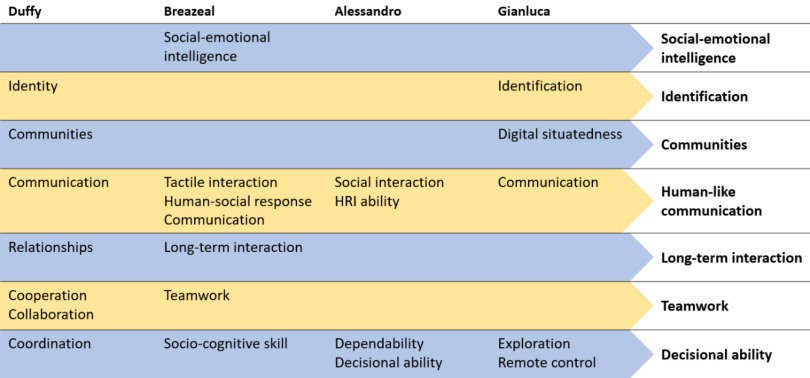
- Literature review: definitions and functional requirements of social and elderly care robots (Duffy, Breazeal, Vercelli, Bardaro) were compared to define an elderly care robot and derive the requirements that make users perceive a robot as having a personality.
- Participants: 12 older adults recruited through a senior welfare center in Ulsan, South Korea, all aged 60 or older, living independently in apartments and able to read and write. Group A had six participants aged 60–69 and Group B six aged 70–79.
- Focus group interviews: one 70-minute session per group (140 minutes in total), with an introduction, ice-breaking, a questionnaire on seven topics (personal information, quality of life, future life, physical health, mental health, leisure/hobbies, retirement planning) and an in-depth group interview. A moderator and a recorder ran the sessions, which were video-recorded, and cross-checked their notes afterward.
- Analysis: each group's characteristics were organized by theme, participants were compared to form user types, and the shared emotional, mental and social needs of each type were summarized. Each type was then matched to an expected robot role, and the seven requirements were rated as essential, optional or unnecessary for each role.
Key findings
- Conceptual (literature): seven basic requirements for an elderly care robot to be perceived as having a personality: social-emotional intelligence, identification (recognizing the user and environment), communities (working as part of a group of robots), human-like communication, long-term interaction, teamwork and decisional ability. The paper also proposes a definition of an elderly care robot as a physical, social entity that provides both physical assistance and companionship.
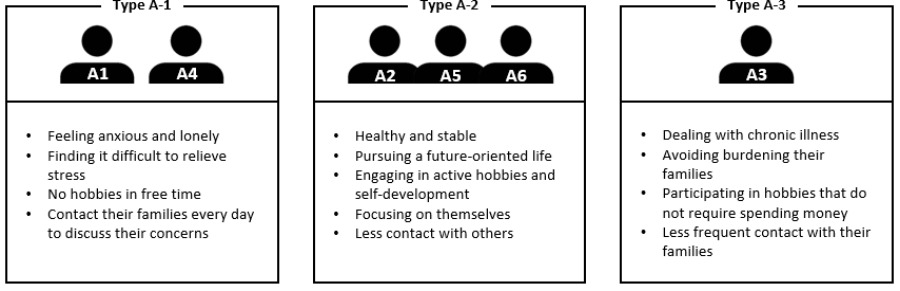
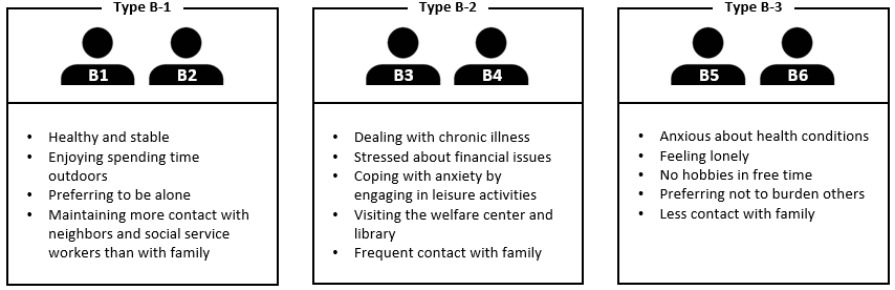
- Empirical (qualitative): all of Group A (60s) named health as their main concern, followed by social disconnection or weakening finances. In Group B (70s), four of six named health as their main concern, five of six had a chronic illness, and they were more likely to report feeling depressed and isolated because of a spouse's death or illness, or their own health.
- Empirical (typology): six user types were identified, three per age group. For example, Types A-1 and B-3 experienced strong loneliness and anxiety, while Types A-2 and B-1 were the most stable.
- Proposed roles: each type was matched to an expected robot role: A-1 butler, A-2 neighbor, A-3 counselor, B-1 friend, B-2 doctor, B-3 daughter. Identification, human-like communication and decisional ability were marked essential for all six roles, while communities and teamwork were marked unnecessary for the counselor and doctor roles.
- Conceptual contribution: "dynamic personality," in which a care robot's expected role can change with the user's physical, mental and social state (for example, a butler role in the user's 60s and a neighbor or friend role in their 70s), and the robot can subtly adjust its behavior within a role.
Figures
Contribution and conclusions
The authors state that the study divides elderly care robot personality into more detailed roles than earlier work, offers robot design researchers a user-centered way to study robot personalities, and gives developers a basis for exploring the technical elements needed. They do not claim that dynamic personality is limited to these six roles. Limitations they list: 12 participants are not enough, and more user types may emerge with more interviews; no participants over 80 were included; only apartment dwellers took part; the gender ratio of each group may have influenced the user types; and focus groups alone are limited, so contextual inquiry through home visits is suggested. Future work includes validating the six dynamic personalities with users, identifying the parameters that define a dynamic personality, and researching the interaction factors needed to express it, since established models such as the Big Five personality traits do not fully capture the concept.