Conference paper2025★ Reviewers' Choice Award, ICED 2025
Scenario to specification: promises and pitfalls of AI in developing user-centered engineering specifications with interdisciplinary teams
Ismatullaev, U. V. U., & Kim, K.
Proceedings of the Design Society, 5, 2841–2850 (ICED 2025)
Publication details
- Type
- Conference paper
- Published in
- Proceedings of the Design Society, 5, 2841–2850 (ICED 2025)
- Year
- 2025
- License
- Open access · CC BY-NC-ND 4.0
In brief
This conference paper tests whether an AI assistant (ChatGPT o1-preview) helps interdisciplinary teams turn user scenarios into engineering specifications using the authors' Action Steps framework. In two workshops, one team worked with AI and one without. The framework was rated moderately to highly usable, and AI improved efficiency, but it did not make outputs more comprehensive or improve collaboration, partly because of information overload and limited understanding of context.
Abstract
This study evaluates a framework for translating user scenarios into engineering specifications with AI integration. We conducted workshops with AI-assisted and non-AI teams to assess AI’s impact on usability, efficiency, and collaboration. We collected data through surveys, interviews, and observations. Results indicate the framework is moderately to highly usable. While AI improved efficiency, it did not enhance output comprehensiveness or collaboration. Information overload and limited contextual understanding hindered AI integration. The study highlights AI’s potential as a technical consultant and interdisciplinary bridge, emphasizing the need for domain-specific training and enhanced interactivity capabilities to optimize human-AI collaboration. These findings underscore AI’s role in engineering design, contributing to scalable methods for developing user-centered specifications.Official abstract, reproduced under the publication’s license. CC BY-NC-ND 4.0
Problem and motivation
Design specification links user needs to engineering solutions, but interdisciplinary teams face communication barriers and find it hard to turn qualitative UX insights into technical parameters. The authors' earlier "Action Steps" framework structures this translation, but the paper notes it is labor-intensive and prone to misinterpretation without shared understanding. Conventional computer-based tools mainly support documentation and modeling, not design reasoning. AI can support reasoning and decision-making, but existing studies rarely examine how well it helps understand user needs, translate them into structured requirements, or support team communication. The study asks how effective the framework is, how AI affects efficiency and collaboration, and how AI tools could be developed further for design specification.
Method and approach
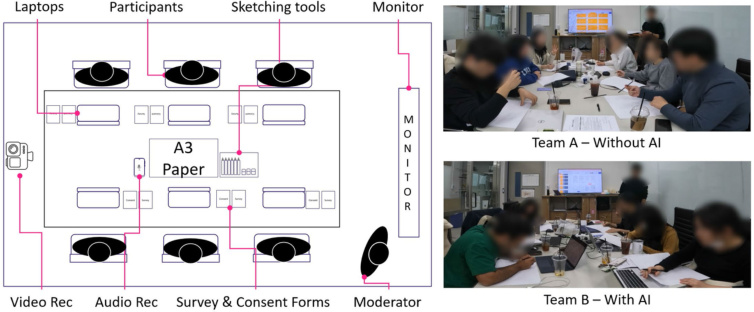
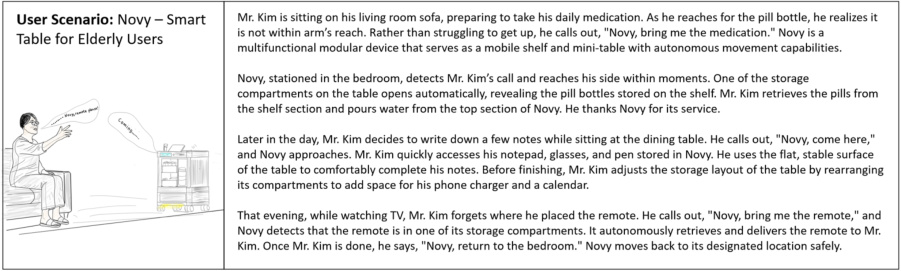
The study compared two workshop sessions, each with a different interdisciplinary team. Team A worked without AI and Team B was AI-assisted. Both teams received the same user scenario ("Novy," a smart table for older users), product concept, materials, Miro templates, time limit and moderator instructions.
- AI setup. Team B used the ChatGPT o1-preview model, preconditioned with a structured prompt, the framework instructions and six reference cases. Each step came with three predefined prompts, and all AI responses had to be documented.
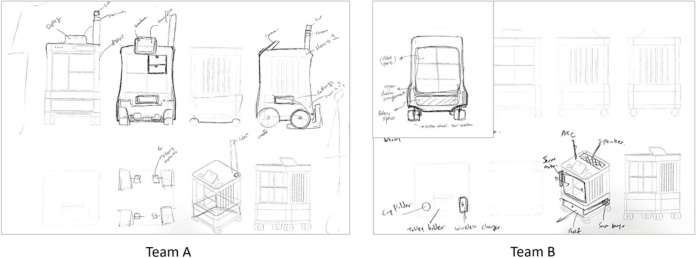
- Procedure. Six timed steps in three stages: identify user and product actions (10 min); build Action Steps (20 min); derive functional requirements (15 min); identify parts and technologies (15 min); define engineering specifications (15 min); and place parts in a layout drawing with the product concept (15 min). Each session lasted 90 minutes, including a 10-minute break.
- Participants. Team A included product design, interaction design, mechanical and electrical engineering experts (mean experience 5.3 years, SD 2.1). Team B included product design, interaction design, electrical and software engineering professionals (mean 3.7 years, SD 1.4).
- Data. Pre- and post-surveys (5-point Likert scales and open questions), focus group interviews, observations and session recordings, team outputs, and AI interaction logs, analyzed quantitatively (ratings, time, number of outputs) and qualitatively.
Key findings
- Empirical result – usability. Participants found the framework intuitive (Team A 4.0, Team B 4.1). Designers rated Steps 1–3 3.7/5 on average across teams. Steps 4–5 were harder (Team A 3.3/5, Team B 3.8/5 with AI), and Step 5, defining specifications, was a bottleneck. Step 6 was rated 3.5 (Team A) and 3.7 (Team B).
- Empirical result – output quality. User-centeredness of specifications scored 3.3 (Team A) and 4.0 (Team B). Innovativeness scored lowest for both teams (2.7), as feasibility constraints in later steps limited exploration.
- Empirical result – efficiency and output. Total times were similar (83 minutes for Team A vs. 81 for Team B). Team B was faster in Steps 2 and 5 but slower in Steps 1, 3 and 4. The authors report that AI reduced task time but did not make outputs more comprehensive; Team A produced more detailed output: 14 user actions and 7 product actions vs. 10 and 8; 12 vs. 11 functional requirements; 24 vs. 18 parts and technologies; 17 vs. 8 specifications; and 19 vs. 16 layout placements. AI interaction logs showed Team B explored more parts than appeared in its outputs, which the authors attribute to information overload and extensive cross-checking.
- Empirical result – collaboration. Team A showed stronger interdisciplinary integration through iterative discussion. Team B's collaboration was more fragmented, with more individual decision-making around AI outputs.
- Design implications (proposed). The authors see AI's potential as a technical consultant, a bridge between disciplines and a knowledge repository. To address its pitfalls, they suggest domain-specific training, offering alternatives with trade-offs, tiered information delivery, explainable recommendations, interactive prompts that ask teams targeted questions, and embedding AI in collaborative tools such as Miro or Figma.
Figures
Contribution and conclusions
The authors conclude that the framework aligned user needs with engineering specifications but was challenging in later technical steps. AI improved efficiency and supported technical decisions but led to information overload and less collaborative innovation, while the non-AI team integrated disciplines more strongly. They argue that successful AI integration requires domain-specific training, contextual understanding and interactive capabilities. Limitations: the study is described as a pilot investigation. Future work: larger and more diverse samples with repeated experiments, AI tools refined with domain-specific data, structured AI–human interaction protocols, and AI-assisted workflows in detailed design and validation.