학회 논문2023
Toward more considerate designing of home exercise equipment for older adults: a qualitative analysis of the specific needs and challenges of older adults for physical exercise
Kim, J., Kim, K., Saduakas, A., Barrera Garza, B. P., Lee, D., & Ismatullaev, U. V. U.
IASDR 2023
출판 정보
- 유형
- 학회 논문
- 게재지
- IASDR 2023
- 연도
- 2023
- 라이선스
- 오픈 액세스 · CC BY-NC 4.0
요약
The study explores what designers should consider when creating home exercise equipment for older adults. After reviewing literature and media, the authors interviewed seven older women at home in Ulsan, South Korea, and analyzed the data with affinity diagrams. The result is a description of why and how older adults exercise and what holds them back, ten design considerations, and four example design ideas.
초록
The elderly population is increasing worldwide, particularly in Korea. The deterioration of older adults' physical condition and related diseases are one of the major problems that make their lives difficult, and exercise is one of the best ways to solve this problem. This research aims to explore what factors should be considered when designing home exercise products for older adults. We investigated literature and media related to older adults’ exercise. Then, we interviewed elderly participants to understand the status and context of their exercise. We analyzed the interview using an affinity diagram. As a result, we drew out ‘the reasons, status, and obstacles of older adults' exercise’ and derived ‘design considerations for home exercise equipment for older adults’ and suggested ‘design ideas for home exercise equipment for older adults.’ Those can be used when designing or evaluating exercise equipment for older adults. We hope this study can positively impact the design of products for older adults and their healthy lives.공식 초록으로, 해당 논문의 라이선스에 따라 게재합니다. CC BY-NC 4.0
문제와 연구 배경
The elderly population is growing worldwide, especially in Korea. Physical decline and related diseases are major problems for older adults, and the paper describes exercise as one of the best ways to address them. To exercise safely, older adults need to know which parts of their body are weak and how to avoid stressing their joints. Because this knowledge is hard to acquire, many rely on simple stretching or walking. The authors found it hard to locate a user-centered study on exercise equipment designed around older adults' characteristics. Their review also found few home products that focus on exercises beneficial for older adults, and noted discomforts with resistance bands.
연구 방법
- Literature and media review: papers, books, YouTube videos, documentaries and exercise-equipment company websites, covering three areas: common musculoskeletal disorders and suitable exercises, motivation and obstacles to exercise, and home exercise equipment.
- Participants: seven women aged 65–80, recruited through a senior welfare center in Ulsan, South Korea. The authors focused on women because statistics show older women rate their health less positively and exercise less than older men.
- Home-visit interviews: semi-structured interviews of about one hour each, based on 52 questions on five topics (perceptions of exercise, exercise habits, goal and plan setting, strength training, indoor exercise equipment). Participants also filled in an exercise goal and plan template and commented on eight images of home exercise equipment in three categories: smart equipment with digital services (Peloton, Lululemon mirror, Tempo, Tonal), conventional equipment and design concepts for older adults.
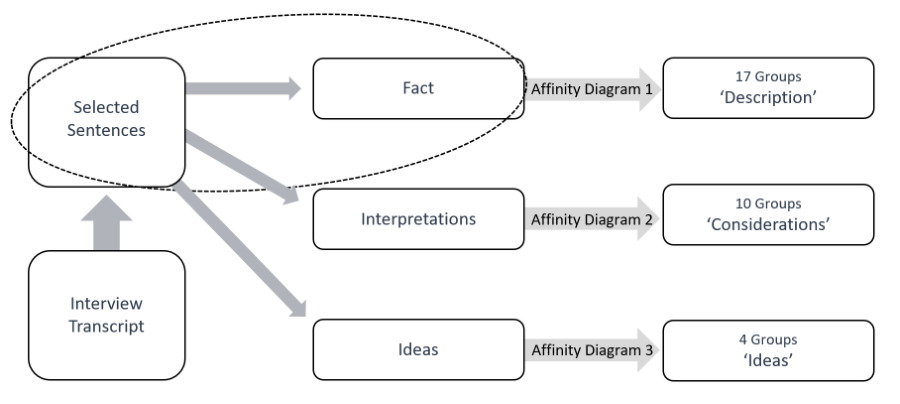
- Analysis: transcribed statements were sorted into "facts," "interpretations" and "ideas," and an affinity diagram (the KJ method, which groups related data into themes) was built for each category.
주요 결과
- Empirical (qualitative, 17 groups from "facts"): participants exercise to stay healthy and able to manage daily life. Their weakened bodies are both a motivation and an obstacle. All reported having experienced musculoskeletal disorders, mainly of the back and knees. They try to stay between too little and excessive exercise, and some had injured themselves while pursuing exercise goals.
- Empirical (qualitative): participants preferred group programs at the senior welfare center and outdoor walking because of the social and emotional benefits, and used smartphone pedometer apps to track their steps. Scheduling, limited places, high intensity, instructors and weather sometimes kept them from group or outdoor exercise.
- Empirical (qualitative): home exercise was treated as a last resort, done without plans and with doubts about correct posture. Most did not use the exercise equipment they owned regularly.
- Design guidelines (10 groups from "interpretations"): choose movements suited to older adults' musculoskeletal characteristics; provide criteria and alerts for excessive exercise; educate on exercise principles and effects; guide and confirm proper posture; assist in setting exercise plans; measure and report exercise volume; use a design that is not burdensome in appearance and operation; help users feel the rewards of exercise; consider the overall exercise experience; and keep the product simple.
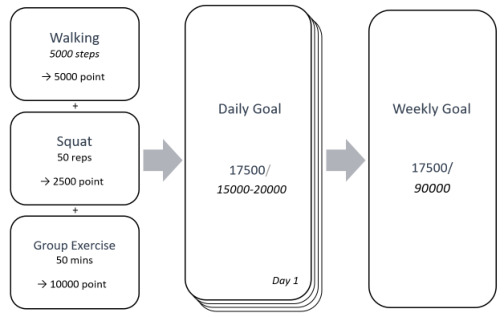
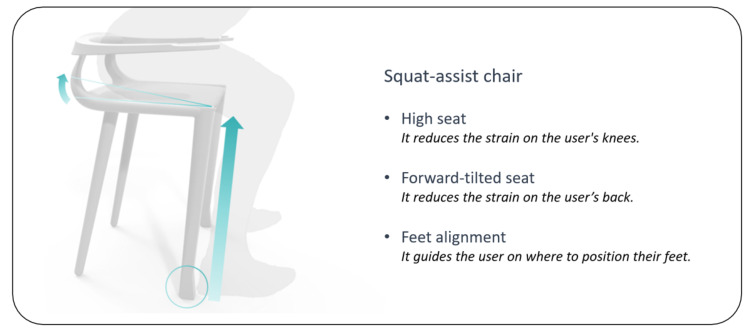
- Proposed design ideas (4 groups from "ideas"): integrated exercise tracking with flexible goals (e.g., counting one squat as 100 steps, and setting a weekly goal lower than seven times the daily goal), an exercise assistant (virtual or physical, such as a companion robot) that helps before, during and after exercise, a friendly, self-explanatory form (e.g., a "squat chair" with a high, forward-tilted seat), and gamification, which the authors note may be hard for some older users to keep using.
그림
기여와 결론
The authors conclude that older adults' weakened physical condition acts as both a motivator and an obstacle to exercise, that they try to balance overexertion and inactivity, and that they prefer group or outdoor exercise for its social and emotional benefits. Participants valued three kinds of benefits from exercise (social, emotional and satisfaction from physical change), none of which seemed to come from home exercise, which might explain why they struggle to keep it up. The considerations and ideas are offered for designing or evaluating exercise equipment for older adults. Limitations stated by the authors: a small number of female participants, all senior welfare center users from a single area, living in environments well suited to group and outdoor activity, so the findings may not apply to all older adults. Future work includes studying male and more diverse older adults, and designing exercise equipment and testing it with older adults.