Доклад на конференции2025
A Component-Based Approach for Developing Actions in Non-Humanoid Elderly Care Robots
Sarfraz, D., Ismatullaev, U. V. U., & Kim, K.
IASDR 2025
О публикации
- Тип
- Доклад на конференции
- Опубликовано в
- IASDR 2025
- Год
- 2025
- Лицензия
- Открытый доступ · CC BY-NC 4.0
Кратко
The paper presents a method for designing the movements of Lemmy, a two-wheeled, non-humanoid companion robot for older adults, by breaking each action into four motion components: speed, posture, path and turn type. Older adults picked their preferred version of each component from 3D animations, and whole actions built from the preferred components then received the highest ratings from a new group of older participants. The authors present this as preliminary, directional evidence that tested components can be recombined into new, user-aligned actions without re-testing every action.
Аннотация
Developing expressive motion for non-humanoid companion robots is a growing area of research in human–robot interaction. This study presents a hybrid design approach that integrates designer-led ideation with user-based empirical validation to develop physical actions for Lemmy, a two-wheeled companion robot for elderly users. The research followed a three-stage process: designer workshops produced an initial action catalogue; pairwise comparison testing with older adults identified preferred variants of four key motion components, speed, posture, path, and turn type, and validation studies compared complete actions composed from preferred, non-preferred, and random combinations. High-fidelity 3D animation was employed to enable rapid iteration, experimental control, and parallel progress while the physical prototype remained under development. Results from 25 elderly participants showed consistent preferences for dynamic posture, smooth turning, and moderate speed, confirming that component-level optimization enhances perceived comfort and naturalness. Crucially, the findings demonstrate that once user-preferred motion components are established, they can be recombined to generate new, user-aligned actions without exhaustive re-testing. The proposed approach thus offers a scalable, designer-accessible method for creating expressive motion in non-humanoid companion robots for eldercare contexts.Официальная аннотация приводится на условиях лицензии публикации. CC BY-NC 4.0
Проблема и мотивация
Non-humanoid companion robots have no face or limbs, so they must convey intent, emotion and social presence through movement alone. The paper states that movement expressivity in such robots is still poorly understood, especially in eldercare, where acceptance depends on perceived safety and predictability. It identifies three gaps: theories of expressive motion rarely become practical design methods; participatory design with older adults is limited by cognitive load, fatigue and limited technical fluency; and no validated method exists for breaking robot actions into designable components that can be optimized and recombined. As a result, robot motion often comes from ad hoc intuition, which risks not matching older users' comfort and expectations.
Метод и подход
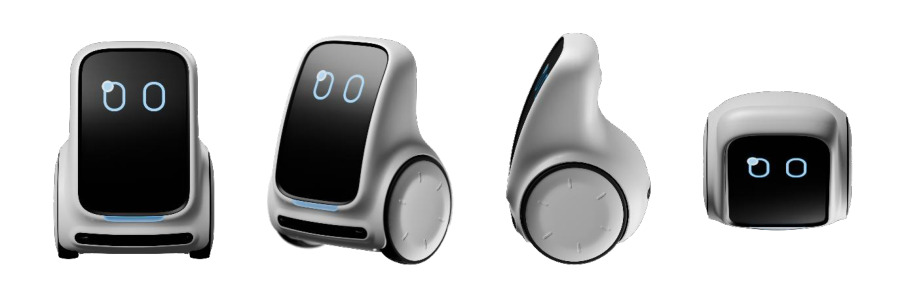
A three-stage hybrid process that combines designer-led ideation with user testing, run on a high-fidelity digital twin of the robot (CAD model imported into Blender) so that studies could proceed before the physical prototype was ready.
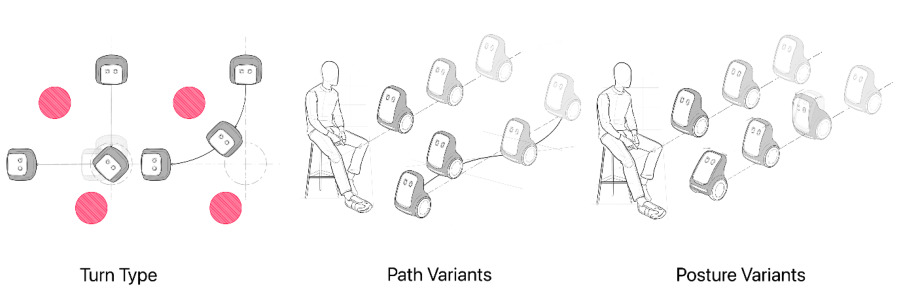
- Platform: Lemmy self-balances on two wheels, can lean forward and backward by 20°, and uses differential drive (it is non-holonomic, meaning it cannot slide sideways, and turns on the spot by pivoting). All animations were kept within these physical limits.
- Stage 1, action catalogue: a workshop with six designers (three teams of two), working from three user stories about older adults' routines, listed and clustered candidate robot actions.
- Component identification: semi-structured interviews (30–60 minutes, online) with five external professional designers led to four components: speed, posture, path and turn type.
- Stage 2, component preferences: each component had two variants: normal speed (≈0.5–0.7 m/s) vs. fast (>0.7 m/s); static upright vs. dynamic leaning posture; straight vs. curved (sinusoidal) path; sharp pivot vs. smooth arc turn. In a within-subjects paired-comparison test, 25 participants aged over 65, all based in Pakistan, watched 3D animations and chose their preferred variant.
- Stage 3, action validation: three actions ("approach user," "return to dock" and a "dancing" action) were built in four variants: V01 from preferred components, V02 from non-preferred components, and V03–V04 from random combinations (turn type was left out). A new group of 15 participants rated 12 videos on a 10-point Likert scale and gave brief written comments.
Основные результаты
- Empirical (component preferences, n = 25): normal speed was chosen in 20/25 cases (80%), straight path in 17/25 (68%), dynamic posture in 16/25 (64%) and arc/smooth turns in 16/25 (64%). The authors treat this combination as the default configuration.
- Empirical (action ratings, n = 15): across all three actions, actions built from preferred components (V01) scored highest (M = 7.67, SD = 1.43, 95% CI [7.24, 8.10]), followed by the random combinations V03 (M = 6.33) and V04 (M = 6.20), with the non-preferred assembly V02 lowest (M = 5.33).
- Empirical (per action): for "return to dock," V01 had the highest mean and smallest spread (M = 8.47, SD = 0.88), and its confidence interval did not overlap with any other variant. For "approach user," V01 also led (M = 7.53). For "dancing," V01 (M = 7.00) was closely followed by V03 (M = 6.73), and the authors suggest users tolerate departures from the baseline when an action is expressive rather than task-oriented.
- Interpretation, with caveats: the authors state that the main hypothesis is validated, but they also describe the evidence as preliminary and directional. Preferences for posture, path and turn type did not reach significance in the initial sample, and action-level inference would require a repeated-measures model, so the results need confirmation in larger studies with the physical robot.
- Proposed method: a "component-first" pipeline: set the robot's physical constraints, enumerate actions in designer workshops, derive interpretable components through expert interviews, test component preferences with low-burden paired comparisons, store the results as a library of "component priors," compose new actions from them, and validate a small set on the physical robot, feeding any discrepancies back into the library.
Иллюстрации

Вклад и выводы
The authors present a designer-accessible, scalable method in which preferences measured cheaply at the component level indicate which whole actions users will rate higher. They argue that this reduces the burden on older participants and separates early motion design from hardware availability. Limitations stated by the authors: Lemmy has few moving parts, which narrows the range of legible cues; each component was tested as a binary contrast, which can blur what participants actually preferred; animations leave out real interaction (timing, personal space, collision avoidance); animated motions may not always be physically achievable; and the sample was small and from a single national context, with an even smaller convenience sample for validation. Future work includes augmented- or mixed-reality testbeds, automated physical-feasibility checks during animation, larger samples stratified by age and culture, and graded rather than binary manipulations, for example speed–comfort curves.